Financial RSS Feeds
https://www.investing.com/rss/news.rss
https://cointelegraph.com/rss

Digital asset treasury stocks surged Tuesday, with Ether-focused firms leading gains up to 12.35% as crypto markets rebounded from the sell-off.

BlackRock is the largest asset manager in the world, with over $13.4 trillion in assets under management, and operates the largest tokenized cash market fund, worth $2.8 billion.
https://www.coindesk.com/arc/outboundfeeds/rss/
https://cryptobriefing.com/feed/
This partnership could accelerate institutional adoption of crypto by aligning staking services with traditional finance standards and security.
The post Deutsche Bank-backed Taurus partners with Everstake to enhance institutional crypto staking appeared first on Crypto Briefing.
Tokenization's potential to revolutionize financial systems could reshape market dynamics and investment strategies, impacting global asset management.
The post BlackRock CEO Larry Fink, Brian Armstrong to discuss tokenization at DealBook Summit appeared first on Crypto Briefing.
https://bitcoinist.com/feed/
Grayscale Research has gone against the grain, rejecting Bitcoin’s popular 4-year cycle thesis and saying new highs could be possible next year.
Grayscale Research Doesn’t Believe A Prolonged Bitcoin Decline Is Coming Yet
In a new report, Grayscale Research has discussed what the latest pullback in the market could mean for Bitcoin. This drawdown, which began in early October and lasted until two-thirds of the way into November, resulted in a price decrease of about 32% from peak to trough.
While the scale of the drop hasn’t been small, Grayscale has noted that it has still been close to the historical average for bull market drawdowns. “Since Bitcoin’s price bottomed in November 2022, it has declined at least 10% nine times,” said the crypto asset manager’s research arm. “It has been a bumpy ride, but not atypical for a Bitcoin bull market.”
2026 will mark four years since the 2022 bear market. Among BTC traders, there is a popular idea that the cryptocurrency’s price cycles run over a length of roughly four years. According to this thesis, the next year could see the asset go down, as it has now enjoyed three years of appreciation.
The 4-year cycle thesis originates from the fact that Bitcoin Halving events are spaced apart by approximately four years. During such an event, BTC’s block subsidy, a fixed reward that miners receive for adding the next block to the chain, is slashed in half.
As the block subsidy is the only way to mint more of the cryptocurrency, Halvings have a direct effect on its supply growth. This scarcity effect of the Halving is what has made many in the community believe that the event sits in the center of bullish phases.
Historically, Bitcoin has seen large drawdowns about every four years, which has strengthened the belief in the idea of a cycle being four years in length. Grayscale doesn’t think that the current cycle will go the same way, however. “Although the outlook is uncertain, we believe the four-year cycle thesis will prove to be incorrect, and that Bitcoin’s price will potentially make new highs next year,” explained the report. Grayscale Research has given three reasons for this expectation.
The first is the fact that the latest BTC cycle hasn’t seen any phase of parabolic price increase, as the below chart highlights.

The second is that Bitcoin has seen a shift this cycle, with instruments like exchange-traded funds (ETFs) and digital asset treasuries (DATs) bringing in fresh capital. Before, BTC relied on inflows through retail exchanges.
Lastly, Grayscale has pointed out that the macro market backdrop is still looking favorable for cryptocurrencies; the potential for lower interest rates and continued progress on bipartisan digital asset legislation could drive institutional investment.
BTC Price
At the time of writing, Bitcoin is floating around $87,000, unchanged from one week ago.
Canary Capital CEO Steven McClurg has thrown fuel on the long-running debate over privacy coins, branding Zcash’s latest rally a “pump and dump” which has been rug-pulled while promoting Litecoin as his preferred privacy asset for regulated markets.
Litecoin Better Than Zcash?
In a series of posts on X, McClurg said the Zcash surge that began roughly two months ago “triggered my curiosity.” After revisiting the project for the first time since 2016–2017, he wrote that he initially “bought into the Zcash narrative” but ultimately reached two conclusions.
“Litecoin has broader reach in terms of users, and MWEB an easier tool for selecting private wallets/transactions. It is my choice for privacy in US or UK due to compliance,” he argued. By contrast, “ZEC is a pump and dump getting ready to rug-pull. Be careful out there,” he posted last week via X.
Via X, McClurg followed up by highlighting Zcash’s sharp reversal on Monday. “Zcash [is] down 50% since this post. I hope people saw the post survived the rug pull. There is still further down to go,” he wrote, attributing the move to “a stunt by bad actors.” He did not name specific counterparties, venues or structures, and his language focused on market behavior rather than protocol design.
Despite the harsh assessment of recent trading, McClurg stressed that his criticism is not a rejection of Zcash as a technology. “Btw, I have nothing against ZEC, as it was the first currency with private/public option,” he said. In the same thread he described himself as “longterm bullish on Litecoin, Monero, Dash, and Zcash in that order,” explicitly placing ZEC last in his personal privacy stack but still on the list.
The distinction he draws hinges on how privacy is implemented and how that interacts with compliance. Litecoin’s MimbleWimble Extension Block (MWEB) design adds an optional confidential layer alongside the transparent base chain, allowing users to move coins into a separate privacy domain while leaving total supply auditable. That structure, plus Litecoin’s broader distribution and exchange support, underpins McClurg’s claim that LTC is “my choice for privacy in the US or UK.”
Pressed on Monero’s role, McClurg said he has not researched it “in several years” but that, based on earlier work, he “always felt that it would be the winning currency for people in authoritarian regimes. Pure privacy.” At the same time, he added that Monero is “unfortunately likely not compliant for US citizens (not that it shouldn’t be),” capturing the tension between default privacy and current regulatory expectations.
Zcash, with its dual transparent and shielded address system, historically sat between those two poles. McClurg’s comments suggest that, in his view, the recent ZEC rally and crash reflect structural weaknesses in how the market around the asset is behaving, even if the underlying cryptography remains important.
He closed by warning that he hopes “this stunt by bad actors didn’t damage the importance of privacy chains and privacy features,” underscoring that his target is speculative excess rather than the broader push for on-chain financial privacy.
At press time, ZEC traded at $324.

https://cryptoslate.com/feed/
Bitcoin was launched fifteen years ago. The industry has ballooned into a nearly $4 trillion ecosystem, yet Satoshi’s vision of everyday payments remains largely unfulfilled. The hope for peer-to-peer payments has shifted to stablecoins. But rather than replacing banks, stablecoins risk becoming bank-like infrastructure. Stronger regulation in the U.S. and Europe may push them toward centralized rails rather than open money.
Regulation turning stablecoins into regulated payment networks
In America, the GENIUS Act established a federal framework for payments with stablecoins—who can issue them, how to back them up, and how they’re regulated. In Europe, MiCA regulation (Markets in Crypto-Assets) became applicable in 2024 and set strict requirements for stablecoins under categories like “e-money tokens” and “asset-referenced tokens.”
These regulations foster legitimacy and safety, but at the same time push stablecoin issuers into the world of banks. When issuers need to comply with reserve, audit, KYC, and redemption requirements, the structure and essence of stablecoins shift. They become centralized gateways rather than peer-to-peer money. Over 60% of corporate stablecoin usage is cross-border settlement, not consumer payments. Stablecoins are becoming more institutional tools and fewer tokens for individuals.
The danger: becoming the next SWIFT
What does it mean to “become the next SWIFT”? It means evolving into the go-to rail for institutions; efficient yet opaque, centralized yet indispensable. SWIFT transformed global banking by enabling messaging between banks; it did not democratize banking access. If stablecoins mirror that evolution, they’ll deliver faster rails for existing players rather than empowering the unbanked.
Crypto’s promise was programmable money—cash that moves with logic, autonomy, and user control. But when transactions require issuer permission, compliance tagging, and monitored addresses, the architecture changes. The network becomes compliant infrastructure, not money. That subtle but profound shift may make stablecoins less radical and more reactionary.
A better path to open rails with compliance baked in
The challenge is not regulation; it’s design. To uphold the promise of stablecoins while adhering to regulatory demands, developers and policymakers should embed compliance in the protocol layer, maintain composability across jurisdictions, and preserve non-custodial access. Back in the real world, initiatives like the Blockchain Payments Consortium provide a glimpse of hope that standardizing cross-chain payments is possible without sacrificing openness.
Stablecoins must work for individuals, not just institutions. If they serve only large players and regulated flows, they won’t disrupt—they’ll conform. The design must allow true peer-to-peer movement, selective privacy, and interoperability. Otherwise, the rails will lock us into old hierarchies, just faster.
Stablecoins still hold the potential to rewrite money. But if we allow them to become institutionalized rails built for banks rather than people, we will have replaced one central system with another. The question isn’t whether we regulate—stablecoins will be regulated. It’s whether we design for inclusion and autonomy, or lock in yesterday’s system behind digital wrappers. The future of money depends on which path we choose.
The following is a guest post and opinion from Joël Valenzuela, Director of Marketing and Business Development at Dash.
The post Stablecoins were built to replace banks but on course to becoming one appeared first on CryptoSlate.
XRP spot ETFs have posted one of the most consistent inflow streaks of this quarter, attracting roughly $756 million across eleven consecutive trading sessions since their Nov. 13 launch.
Yet the strength in the ETF demand contrasts with XRP’s price performance.
According to CryptoSlate’s data, the token has fallen about 20% over the same period and currently trades near $2.03.

This divergence has prompted CryptoSlate to examine how XRP’s ownership structure is shifting beneath the surface.
The strong ETF inflows alongside falling prices point to a market absorbing two opposing forces of steady institutional allocation on one side and a broader risk reduction on the other.
Essentially, this pattern reflects a more complex process in which new, regulated demand is entering the ecosystem as existing holders adjust their exposure.
XRP dominates crypto ETFs flow
The inflow profile of XRP products is statistically remarkable, particularly against a backdrop of net redemptions elsewhere.
During the reporting period, Bitcoin ETFs saw over $2 billion in outflows, and Ethereum products recorded nearly $1 billion in withdrawals.
Even high-flying competitors like Solana have managed only about $200 million in cumulative inflows. At the same time, other altcoin ETFs have drawn smaller totals, with Dogecoin, Litecoin, and Hedera products each holding between $2 million and $10 million.
In this context, XRP stands alone for its consistent accumulation, with the four products now holding about 0.6% of the token’s total market capitalization.

Considering this, market participants attribute the demand to the ETF’s operational efficiency. The four XRP funds offer institutional allocators a compliant, low-friction path into the asset, bypassing the custody headaches and exchange risks associated with direct token handling.
However, the fact that these inflows have not translated into upward price pressure suggests that other market segments may be reducing exposure or managing risk amid elevated macro and crypto-specific uncertainty.
This phenomenon is not unprecedented in crypto, but the scale here is distinct.
The selling pressure is likely originating from a combination of early adopters cashing out after years of volatility and potential treasury movements. The ETF boom has essentially created a liquidity bridge, allowing large-scale entities to offload positions without crashing the order book instantly.
Consolidation or centralization risk?
Meanwhile, the ownership data below the surface reinforces the view that the asset is undergoing a radical centralization.
Data from blockchain analysis firm Santiment indicates that the number of “whale” and “shark” wallets holding at least 100 million XRP has plummeted by 20.6% over the past eight weeks.

This pattern of fewer large wallets with more combined assets can be interpreted in different ways.
Some market observers have framed this as “consolidation,” arguing that supply is moving into “stronger hands.”
However, a risk-adjusted view suggests rising centralization risk.
With nearly half of the available supply concentrated in a shrinking cohort of entities, the market’s liquidity profile is becoming increasingly fragile.
This centralization of supply means that future price action is heavily dependent on the decisions of fewer than a few dozen entities. If this group decides to distribute, the resulting liquidity shock could be severe.
Simultaneously, spot exchange balances are thinning as tokens move into the regulated custody solutions required by ETF issuers.
While this theoretically reduces the “float” available for retail trading, it hasn’t triggered a supply shock. Instead, the transfer from exchange to custodian appears to be a one-way street for now, soaking up circulating supply sold by the shrinking whale cohort.
The benchmark race
The inflow streak has renewed discussion about which asset could emerge as the benchmark altcoin for institutional portfolios.
Historically, regulated crypto exposure has centered almost exclusively on Bitcoin and Ethereum, with other assets attracting minimal attention. XRP’s recent flow profile, which has significantly exceeded the cumulative inflows of other altcoin ETFs, has temporarily shifted that dynamic.
Part of the interest stems from developments around Ripple. The firm’s licensing expansion in Singapore and the significant adoption of RLUSD, its dollar-backed stablecoin, give institutions a broader ecosystem to evaluate.
At the same time, Ripple’s acquisitions across custody, brokerage, and treasury management have created a vertically integrated framework that resembles components of traditional financial infrastructure, offering a foundation for regulated participation.
Still, analysts caution that a short inflow streak does not establish a new long-term benchmark.
XRP will need to sustain demand across multiple market phases to maintain its position relative to peers such as Solana, which has gained attention for its growing tokenization activity, and to assets that may attract larger flows once new ETFs launch.
For now, XRP’s performance within the ETF complex reflects early momentum rather than structural dominance.
The flows highlight genuine institutional interest, but the asset’s price behavior reflects the broader challenges large-cap cryptocurrencies face amid macroeconomic uncertainty.
The post How XRP became the top crypto ETF trade despite price slides toward $2 appeared first on CryptoSlate.
https://ambcrypto.com/feed/
 Why is CZ fighting to control this company?
 The Ethereum L1 vs L2 debate is still raging on..
https://beincrypto.com/feed/
Bitcoin (BTC) price surged more than 6% on Wednesday, pushing toward the $94,000 threshold during the early hours of the Asian session. It comes just hours after Vanguard lifted its long-standing ban on trading Bitcoin ETFs.
The sudden rally triggered one of the strongest intraday moves of the quarter, raising new questions about how much conservative capital may now flow into crypto markets.
A Sudden Bitcoin Price Spike as Vanguard Flips Its Crypto Stance
The Bitcoin price surged above $93,000 on Wednesday, adding over $200 billion to its market capitalization in 36 hours.
The surge began during the US opening on Tuesday. It put Bitcoin on track for its biggest daily gain since May 2021, as the pioneer crypto approached $91,000, with levered short liquidations surging.
According to ETF analyst Eric Balchunas, this surge is attributed to the “Vanguard Effect,” which occurred on the first day after the firm lifted its ETF ban.
As BeInCrypto first reported on December 1, Vanguard has ended its years-long crypto ban. Now, it allows trading of Bitcoin, Ether, XRP, Solana, and other regulated crypto ETFs and mutual funds.
This marks a dramatic departure from its previous position. For years, Vanguard executives have argued that crypto lacks intrinsic value, produces no cash flows, and does not fit long-term retirement strategies.
The firm rejected Bitcoin ETFs after their January 2024 debut and even restricted customer purchases of competing funds. However, from as early as January 2024, analysts predicted the firm would soften its stance.
“Vanguard’s anti-bitcoin ETF stance is totally on brand and would’ve made Bogle proud. That said, I think they will soften in the coming years as they build their advisory business; they’ll need to have access to alternative asset classes,” Balchunas said in a January 13, 2024, post.
Notably, its restrictive stance had compelled many Vanguard customers to redirect their funds to alternative firms. The backlash from clients was swift and decisive, with Vanessa Harris, a former Vanguard client, sharing her experience.
“Just fully transferred my retirement account from Vanguard to Fidelity because Vanguard won’t support Bitcoin ETFs, and appears to be manipulating the price of Bitcoin by only allowing people to sell GBTC, not buy,” Harris said.
The post has since been taken down.
Nonetheless, sustained customer demand, combined with Bitcoin ETFs becoming one of the fastest-growing product categories in US fund history, has forced a strategic reassessment.
Vanguard now says Bitcoin and crypto ETFs have been “tested and performed as designed through multiple periods of volatility.”
While the firm still refuses to launch its own crypto products or support meme coin-linked funds, opening access alone represents one of the most significant institutional shifts of 2025.
Institutional Momentum Surges Through IBIT and Vanguard
Balchunas highlighted that BlackRock’s IBIT ETF reached $1 billion in trading volume within the first 30 minutes, with Vanguard saving Bitcoin just before the Christmas holiday, when trading momentum typically begins.
The wave of inflows was not limited to Balchunas’ observations. Analyst Crypto Rover said the price action was no mystery.
“This is why bitcoin pumped… Vanguard just lifted its Bitcoin ETF ban reversal, and a wave of new institutional investors rushed in through BlackRock’s $IBIT ETF. BlackRock’s $IBIT alone hit over $1.8 billion in trading volume within the first two hours,” he wrote.
Separately, market watcher Vivek Sen reported that Bitcoin ETF volume on Vanguard surpassed $1 billion within the first 30 minutes, describing the surge as “wild.”
These rapid inflows suggest that a portion of previously blocked demand, comprising conservative, retirement-oriented investors who could not access Bitcoin ETFs, may have entered the market as soon as the restriction disappeared.
One-Off Burst or the Start of a Larger Trend?
Despite the excitement, analysts remain divided on whether Vanguard’s reversal marks a structural shift. When asked whether this is a short-term effect after the ban is lifted, or if it is the beginning of a systemic flow of conservative capital into Bitcoin ETFs, Balchunas urged caution.
“I doubt it. I think there’s a small % of ppl who were pent up. And it’s good to be on the platform and available. You never know when others may allocate. That said, you can’t rely on ETF Boomers for everything,” he warned.
The remark highlights a key tension, that while institutional-grade access is expanding, the long-term behavior of traditional investors remains uncertain.
Bitcoin, Ethereum, XRP, and Solana, among cryptocurrencies featured in Vanguard’s new pivot, are rallying. BTC was trading for $93,562 as of this writing, up by nearly 10% in the last 24 hours.
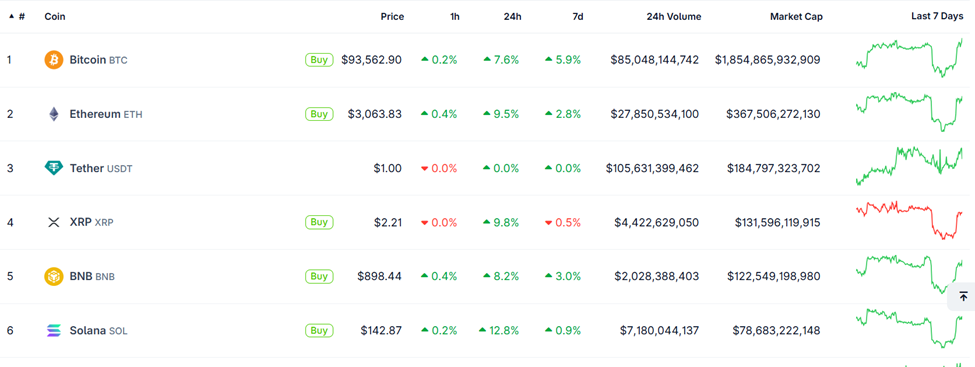
If conservative capital continues to flow into IBIT and other spot ETFs, the market could enter a new phase of liquidity expansion. However, if this spike was merely the release of pent-up demand, momentum may cool quickly.
Either way, Vanguard’s reversal ensures that the wall between traditional finance and crypto just got much thinner, and investors are reacting fast.
The post Vanguard ‘Degen Effect’ Fuels 10% Surge for Bitcoin in Explosive Rebound appeared first on BeInCrypto.
Bitcoin is attempting to recover after a sharp decline, but its rebound remains limited as the crypto king approaches a critical resistance zone.
Despite climbing over the past 24 hours and regaining key levels, Bitcoin still lacks strong investor support, leaving its recovery fragile heading into the week.
Bitcoin Faces Weak Demand
Spot Bitcoin ETFs continue to show weak interest from institutional investors. According to Farside data, spot BTC ETFs registered only $8.5 million in inflows on Monday, followed by $61.6 million in outflows the same day. This occurred despite Bitcoin’s price improving, highlighting a disconnect between price action and investor conviction.
ETF participation is often used as a proxy for institutional sentiment, and the current trend points to skepticism rather than confidence. Without tighter inflow momentum, Bitcoin may find limited support from large buyers, making sustained recovery more difficult.
Want more token insights like this? Sign up for Editor Harsh Notariya’s Daily Crypto Newsletter here

On-chain data also reflects weak fundamental activity. Relative activity among both small and large entities has been declining, signaling reduced engagement across the entire network. When participation drops simultaneously among these cohorts, it often indicates lower demand and weakened market strength.
This reduction is weighing on Bitcoin’s price momentum. Lower interaction from whales and retail entities alike constrains organic buying pressure, which is essential for supporting higher valuations. Until this activity rises, Bitcoin may struggle to gather the strength needed to break major resistances.
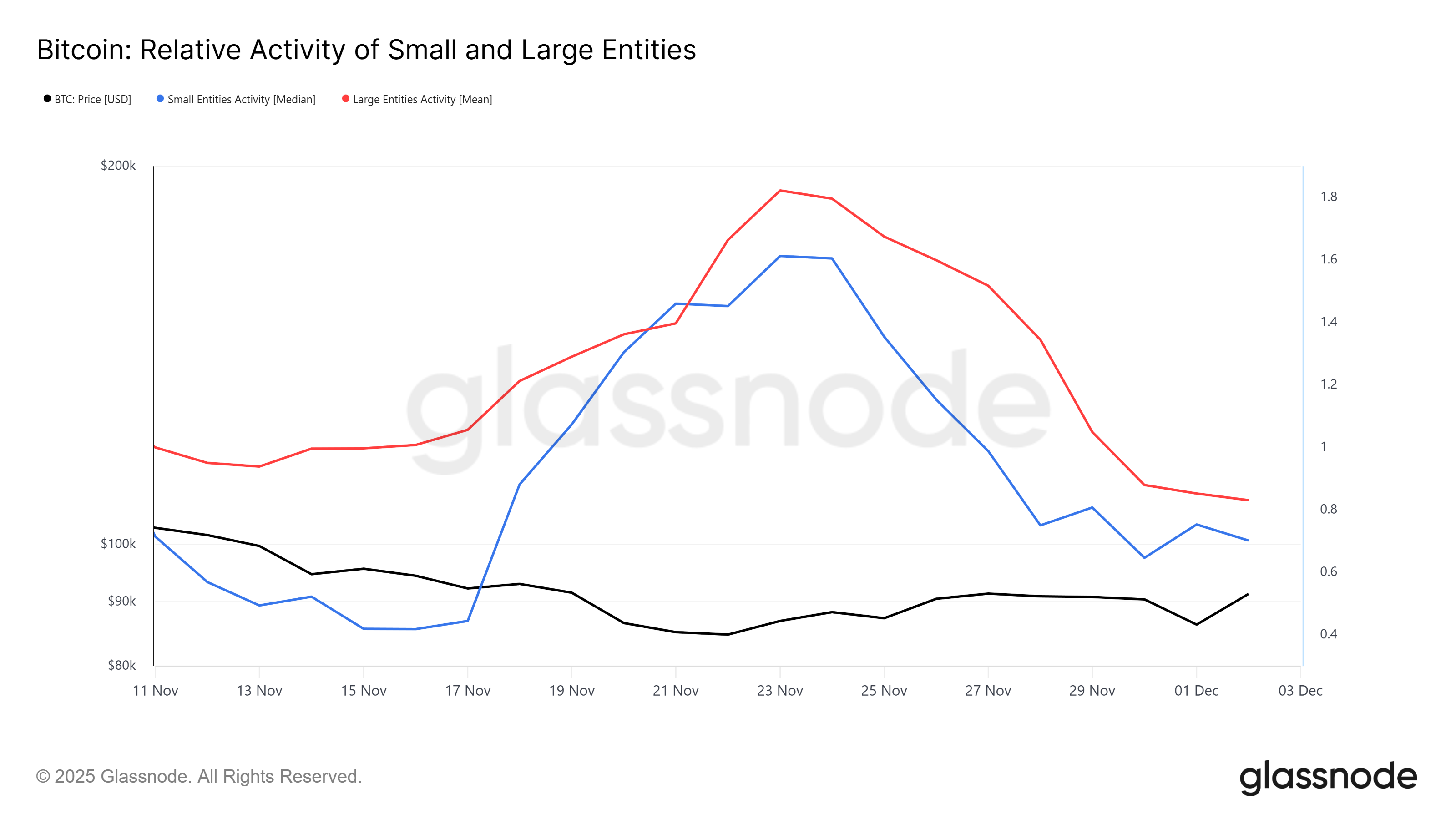
BTC Price Needs To Breach This Resistance to End Downtrend
Bitcoin’s price is trading at $92,939 at the time of writing, having successfully breached the $91,521 resistance. The next major target is $95,000, a level that determines whether Bitcoin can shift from recovery to a meaningful uptrend.
If demand does not improve and Bitcoin faces rejection at $95,000, the price could fall back below $91,521 and subsequently drop under $89,800. A decline to $86,822 remains possible, which would erase recent gains and extend the five-week downtrend.
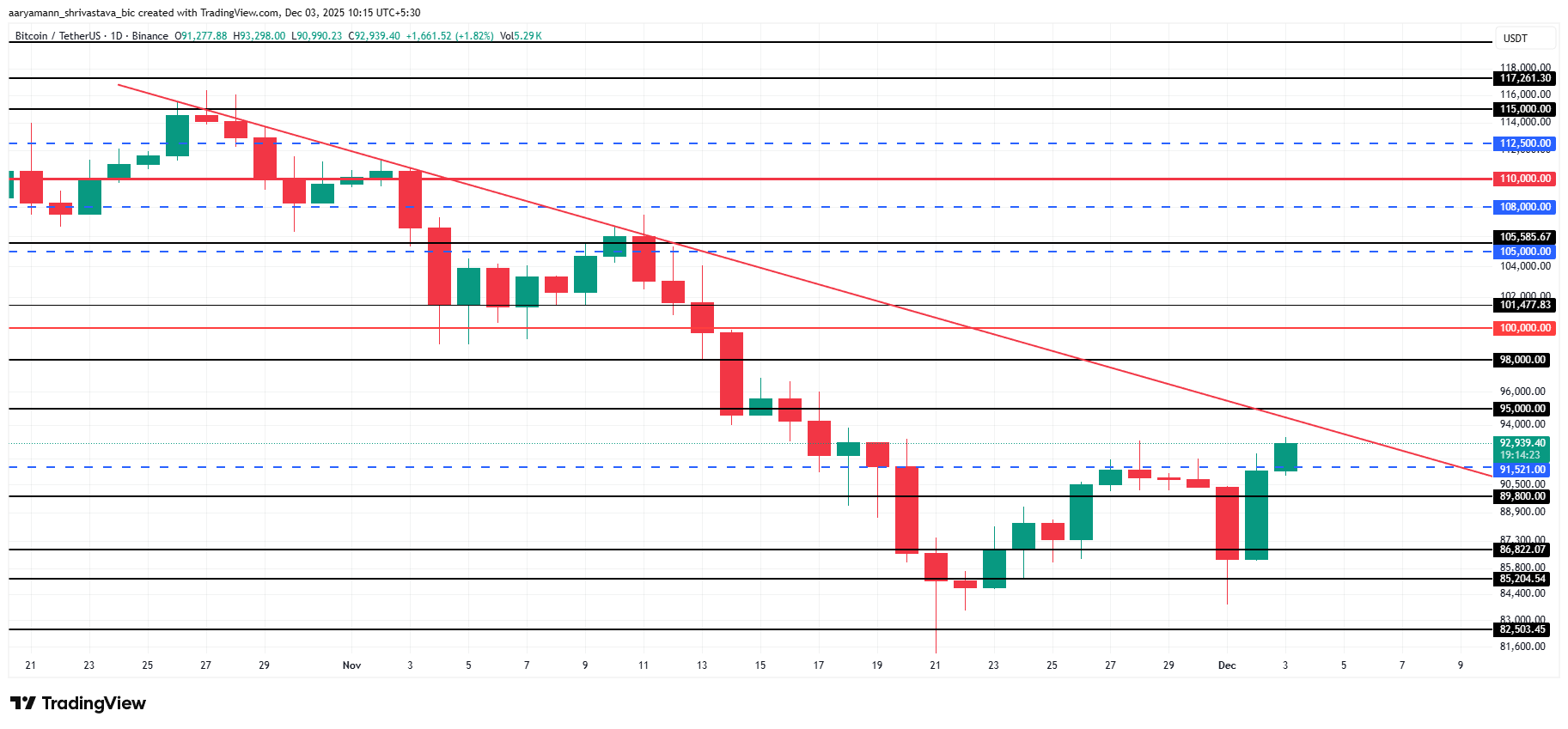
On the other hand, Bitcoin remains capped by the broader downtrend that began five weeks ago. To break this pattern, Bitcoin must flip $95,000 into support. Achieving this would open the path toward $98,000, signaling renewed momentum and invalidating the bearish outlook.
The post Is Bitcoin Ready to End Its 5-Week Downtrend or Face Rejection at $95,000? appeared first on BeInCrypto.
https://cryptonewsz.com/feed/
https://www.newsbtc.com/feed/
Despite a 9% recovery on Tuesday, Bitcoin (BTC) has experienced considerable volatility, with its price plummeting to as low as $84,000 just 24 hours ago. This downturn has had a significant impact on Strategy (previously MicroStrategy) the public company that holds the largest BTC reserves, currently boasting over 650,000 coins.
Strategy T-Rex ETFs Plummet Nearly 85%
NewsBTC reported that the company’s CEO, Phong Le, suggested the possibility of selling some of their Bitcoin holdings in light of the current market conditions.
Alongside this, the company’s leveraged exchange-traded funds (ETFs) have also faced substantial losses, intensifying worries about Strategy’s financial health.
Reuters highlighted that Strategy’s leveraged ETFs, which are designed to magnify returns on the firm’s stock, have been among the largest casualties of this year’s cryptocurrency slump.
Two specific ETFs, the T-Rex 2X Long MSTR Daily Target ETF and the Defiance Daily Target 2x Long MSTR ETF, have seen dramatic declines, losing nearly 85% of their value this year.
Additionally, the T-Rex 2X Inverse MSTR Daily Target ETF has dropped by 48% in the same time frame. In this environment, shares of Strategy, MSTR, have fallen more than 40% this year, driven primarily by Bitcoin’s price crash.
Investor attention is now focused on Strategy’s “mNAV” (market net asset value) metric, which compares the company’s enterprise value to its Bitcoin holdings.
Following Le’s comments, where he mentioned the firm might consider selling cryptocurrencies if the mNAV drops below 1, concerns grew about the firm’s long-term outlook. Current estimates place this ratio around 1.1, according to calculations by Reuters.
Analysts Remain Optimistic
Mike O’Rourke, the chief market strategist at JonesTrading, noted that Le’s remarks diminish the company’s message of steadfastness in holding Bitcoin, even amid market volatility.
The company has also revised its full-year outlook, warning of a potential profit ranging from $6.3 billion to a loss of $5.5 billion, a stark adjustment from its earlier forecast of $24 billion in net profit. This prior estimate, made on October 30, anticipated Bitcoin reaching $150,000 by year-end.
Commenting on the shifting strategies within the firm, Vincenzo Vedda, chief investment officer at DWS, remarked, “Great strategy from Strategy, while prices go up. When they go down, well, the strategic options left to the company are limited.”
Since entering the Nasdaq 100 index, Strategy’s shares have dropped more than 70% from their peak in November 2024, more than halving in value over the year.
Despite this dismal performance, analyst sentiments remain relatively optimistic; of the 16 brokerages monitoring Strategy, 10 recommend it as a “buy” while four suggest a “strong buy,” with an overall median price target of $485, reflecting a potential 183% increase over the next year based on LSEG data.
When writing, the market’s leading cryptocurrency, Bitcoin, managed to recover the $92,000 line.
Featured image from DALL-E, chart from TradingView.com
Solana started a recovery wave above the $135 zone. SOL price is now consolidating and faces hurdles near the $140 zone.
- SOL price started a decent recovery wave above $132 and $135 against the US Dollar.
- The price is now trading above $135 and the 100-hourly simple moving average.
- There was a break above a key bearish trend line with resistance at $138 on the hourly chart of the SOL/USD pair (data source from Kraken).
- The price could continue to move up if it clears $140 and $142.
Solana Price Jumps 10%
Solana price remained stable and started a decent recovery wave above $130, like Bitcoin and Ethereum. SOL was able to climb above the $135 level.
There was a move above the 61.8% Fib retracement level of the downward move from the $145 swing high to the $123 low. Besides, there was a break above a key bearish trend line with resistance at $138 on the hourly chart of the SOL/USD pair.
Solana is now trading above $135 and the 100-hourly simple moving average. It is also above the 76.4% Fib retracement level of the downward move from the $145 swing high to the $123 low. On the upside, immediate resistance is near the $140 level.
The next major resistance is near the $142 level. The main resistance could be $145. A successful close above the $145 resistance zone could set the pace for another steady increase. The next key resistance is $155. Any more gains might send the price toward the $162 level.
Another Decline In SOL?
If SOL fails to rise above the $140 resistance, it could continue to move down. Initial support on the downside is near the $136 zone and the same trend line. The first major support is near the $134 level.
A break below the $134 level might send the price toward the $128 support zone. If there is a close below the $128 support, the price could decline toward the $120 zone in the near term.
Technical Indicators
Hourly MACD – The MACD for SOL/USD is gaining pace in the bullish zone.
Hourly Hours RSI (Relative Strength Index) – The RSI for SOL/USD is above the 50 level.
Major Support Levels – $136 and $134.
Major Resistance Levels – $140 and $142.


